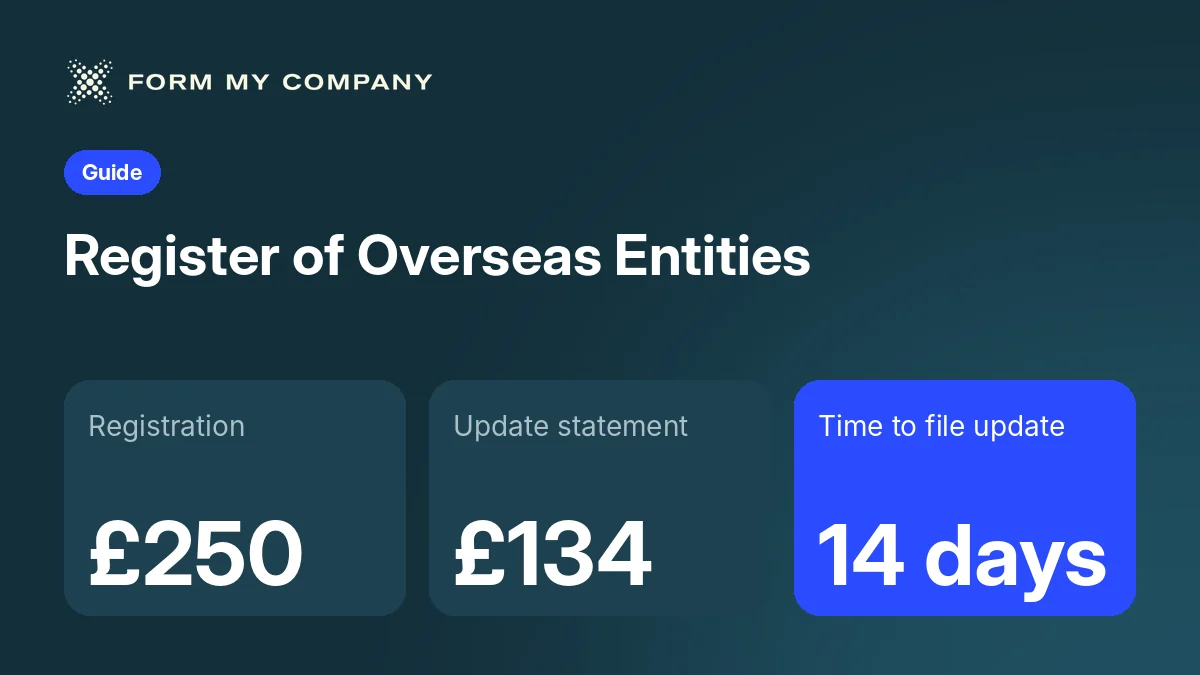
In short: an overseas company, partnership or other entity that owns UK land or property must be on the Register of Overseas Entities at Companies House. A UK-regulated agent must verify its beneficial owners first, no more than 3 months before registration. Registration costs £250 online, and an update statement (£134) is due every year within 14 days of the statement date. Without a valid overseas entity ID, the entity cannot sell, lease or mortgage its UK property.
The Register of Overseas Entities was created by the Economic Crime (Transparency and Enforcement) Act 2022. Its purpose is simple: to show who really owns UK property held through overseas companies and other entities. If your company, partnership, foundation or trust-owned entity is governed by the law of another country and owns land or property in the UK, this guide explains what you have to do.
Who must register
An overseas entity must register with Companies House if it wants to buy, sell, transfer, lease or charge UK land, or if it already owns UK land bought on or after these dates:
| Where the property is | Bought on or after |
|---|---|
| England and Wales | 1 January 1999 |
| Scotland | 8 December 2014 |
| Northern Ireland | 5 September 2022 |
The rules apply to freehold property and to long leases. If you are not sure whether your interest counts, ask before you buy or sell.
What you must disclose
The entity must name its registrable beneficial owners: broadly, anyone who holds more than 25% of the shares or votes, can appoint or remove most of the board, or has significant influence or control. Beneficial owners can be individuals, other legal entities or government bodies. If no beneficial owner can be identified, the entity gives details of its managing officers instead. If trustees are beneficial owners, information about the trust is needed too.
The entity also gives its own details (name, country, legal form, governing law, address and email) and details of any UK property it sold or transferred after 28 February 2022.
Verification by a UK-regulated agent
Companies House will not register an overseas entity until a UK-regulated agent has verified the information. The agent must be based in the UK, supervised under the Money Laundering Regulations 2017, and hold an agent assurance code from Companies House. The checks must be done no more than 3 months before the registration is filed. If registration is delayed, the checks must be repeated.
Fees
| Filing | Companies House fee (online) |
|---|---|
| Registration | £250 |
| Yearly update statement | £134 |
Agents charge separately for verification and filing. At Form My Company, registration is £2,195 including VAT and the £250 fee, for the entity and up to 2 people.
The yearly update statement
Once registered, the entity must confirm or update its information at least once every 12 months. It has 14 days after its statement date to file, even if nothing has changed. Any new or changed information must be verified by a UK-regulated agent first. See our update statement service.
What happens if you don't comply
Failing to register or to file an update statement is a criminal offence. Fines can apply, and officers can face prison. The overseas entity ID also becomes invalid, so the land registries will not register a sale, lease or charge until the entity is back in order. Companies House notes on the public register when an update statement is overdue.
A simple checklist
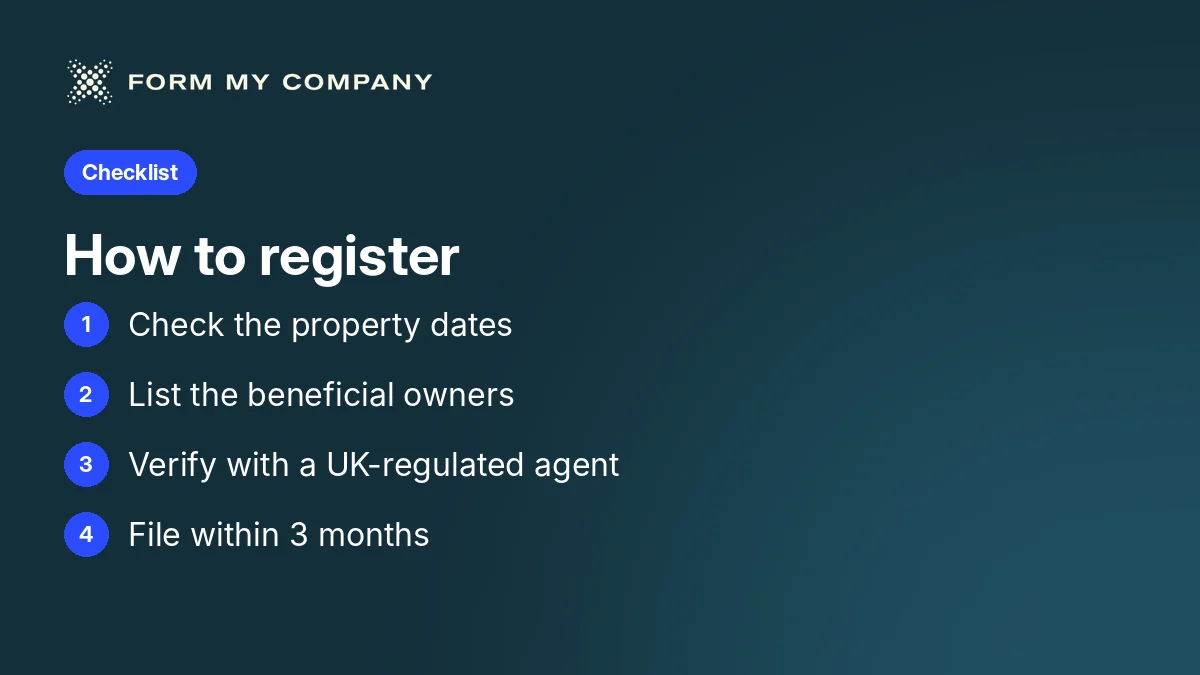
- Check whether the entity owns or will own qualifying UK property.
- List every possible beneficial owner and managing officer.
- Gather identity and address documents for each person, and the entity's own documents.
- Have a UK-regulated agent verify them.
- File the registration within 3 months of the checks.
- Put the update statement date in your calendar every year.
Frequently asked questions
Does a company that only rents UK property need to register?
Usually only if it holds a long lease. In England and Wales, leases granted for more than 7 years are covered. Short tenancies are not. Check the details before you sign.
Can the entity verify its own owners?
No. The verification must be done by a UK-regulated agent supervised under the Money Laundering Regulations 2017, who is not related to or a close associate of the people being checked.
How long does registration take?
Once the checks are complete and the information is ready, the application can be filed straight away. Companies House processing time varies.
Is the information public?
Most of it is on the public register. Some details, such as residential addresses and full dates of birth, are not shown publicly.
Sources
- Register an overseas entity and its beneficial owners — GOV.UK — Companies House, checked 23 November 2026
- File an overseas entity update statement — GOV.UK — Companies House, checked 23 November 2026
- Agent assurance codes — GOV.UK — Companies House, checked 23 November 2026
- Changes to Companies House fees — GOV.UK — Changes to UK company law, checked 23 November 2026
We check every fact against the official source before publishing. Rules change, so always check the latest guidance on GOV.UK.